
Identify Who Owns Glascock Property
Treat ownership as a two-record question. The county's qPublic tax digest gives the assessment name attached to a parcel, and the latest deed in the recorder's deed records names the grantee who received the interest. Dates matter here. The digest and the deed index follow different update schedules, so a dependable Glascock County property search labels each source and its date rather than forcing the two to match. When a name appears in both, your confidence goes up. When they differ, the newer deed usually controls.
- Start with the street address in the Glascock qPublic route. Save the parcel ID, digest year, legal description, and owner label actually displayed.
- Search that name as grantee in the GSCCCA real-estate index, with GLASCOCK selected and a useful date range.
- Open the latest plausible deed when image access permits. Match the legal description, acreage, land lot or district, and prior deed reference to the parcel.
- If the grantee is an entity, check its exact name in Georgia corporate records. Use that filing for identity context, not as proof of the people who own the land.
This approach answers "who owns" with public property records rather than guesswork. Title judgment still belongs to the recorded instruments and qualified professionals. A matching name alone is weak evidence, too. Common surnames, estates, trusts, and multi-tract holdings can all blur the owner of record.
Glascock Owner Search Starts Dated
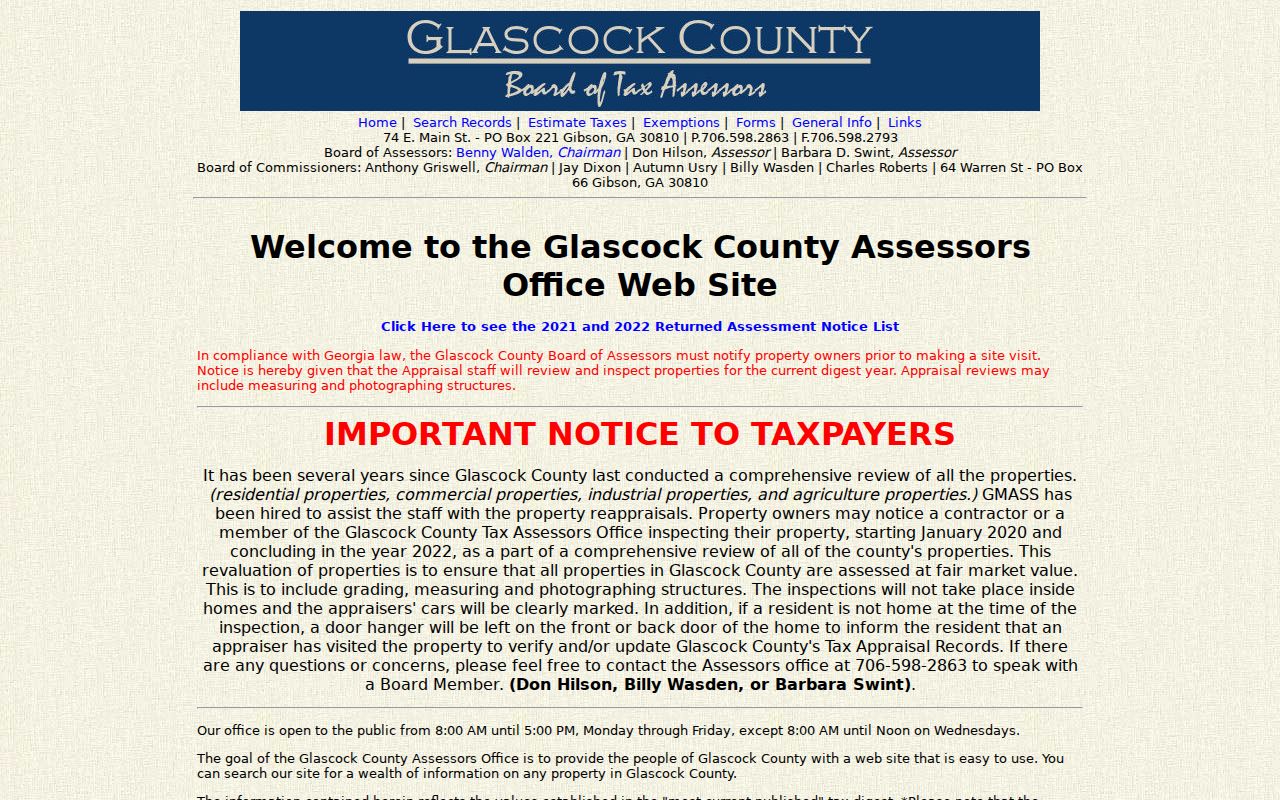
The Board of Tax Assessors describes qPublic as the most current published tax digest for Glascock County. That wording matters. It refers to a published assessment record, not a live title ledger that refreshes with every transfer. The owner-field label, card refresh date, sales columns, and print tools inside the application can shift between visits, so verify details in the live app rather than assuming a card was updated today. Some transfers also take time to appear in either system. The official Glascock qPublic landing page confirms the county assessment route and lists the office contact for questions the digest cannot answer.
The parcel card on the county's owner search sometimes will not load. Ask the assessor at 706-598-2863 instead. Request the current public parcel card. It should show the owner field, the situs address, the mailing address if public, the parcel ID, the legal description, and the digest year. A sales clue and deed reference belong there too. Keep two labels separate. "Owner shown on the digest" and "grantee in the latest deed" can differ, and that timing gap is the whole point of the wording.
Note: An assessor name and a recorded grantee can differ for a time without either record being fabricated.
Recorded Deeds Test Glascock Ownership
In Glascock County, deeds belong to the Clerk of Superior Court. That office records deeds, plats, liens, judgments, and related land instruments. GSCCCA's live name form covers Glascock. It lets you pick party role, instrument type, county, neighboring counties, a name, and a date range. Start with the assessor's owner name as a grantee. Then check warranty, quitclaim, estate, gift, foreclosure, sheriff's, trustee's, and tax-sale deeds, since any of them can explain the present interest.
An index row is only a lead. Open the deed image itself. It can show the legal description, execution and recording dates, grantor and grantee spellings, book and page, the prior deed reference, exceptions, and exhibits. Match those details to your parcel. Glascock's searchable deeds have no published start year. For an older or missing record, call the clerk at 706-598-2084 with the book and page or a narrow name and date range.
Book and page search needs a citation first. An assessment card, a newer deed, or an attorney's file usually supplies one. A name search works differently. Keep the party role, instrument filter, county, date range, and spelling intact; if the query fails, try initials, prior surnames, estate forms, or the other deed party. Shared names call for comparing tracts, not dates.
Glascock Property Owner Evidence
No single database settles ownership in Glascock County. The assessor record, deed index, filed image, entity search, and parcel map each answer a different part. Note the date and search scope each time. That record trail earns its keep after a recent closing, or when the owner is an estate, a trust, or a business.
| Ownership source | What it contributes | Freshness limit |
|---|---|---|
| qPublic digest/card | Assessment name, parcel link, and digest context when shown | May lag a recent conveyance; exact refresh is unverified |
| GSCCCA index and deed | Named parties, instrument, book/page, and filed description | Recently delivered documents may take time to index |
| SOS corporations search | Entity status, agent, officers, and filings | Does not reveal or prove beneficial land ownership |
| qPublic parcel map | Geographic link between a tract and assessment record | Map controls and owner display were not verified |
The person at a site may not own it. Occupancy and mail delivery do not establish ownership. A mailing address can differ from the situs, the physical property address. Trust administration, estate work, a business office, or address-protection measures can each affect what shows up. Never guess a missing owner from another directory.
Trace Glascock Entity Owners Carefully
A deed in Glascock County sometimes names an LLC or a corporation as the grantee. That is where the Georgia Secretary of State Corporations Division earns its keep. Search the exact legal name first. Then try other modes such as control number, registered agent, or officer. The record shows status, registration history, office details, and filed documents. Comparing those details helps you separate similar entities and catch name changes.
One caution belongs here. A registered agent accepts legal papers but may own nothing. The same goes for officers. An entity may have dissolved or merged. In that case, dig into the Glascock County deed index for the conveyance, assignment, or corrective instrument that tells the real story. Trusts and estates call for the same restraint. A trustee's signature or a probate order shows who had authority. Yet the recorded deed remains the actual evidence of who owns the property.
- Owner of record
- The name tied to the parcel in the relevant public roll or recorded instrument, with its date stated.
- Grantee
- The party receiving the interest described in a deed.
- Title
- The legal ownership interest, which cannot be fully established by one index or assessment field.
- Situs address
- The physical property location, distinct from an owner's mailing address.
Protected Glascock Addresses Stay Protected
Georgia Safe at Home gives eligible at-risk residents a substitute address, mail forwarding, and sealed voter-address treatment. VoteSafe separately shields qualifying voter residences. A masked or blank address on a Glascock parcel does not mean the land is unowned. It means the public view is limited.
Never try to reverse-engineer a protected location through tax, voter, business, court, or map sources. A lawful property purpose justifies using the public deed and parcel information the custodians release. A narrow Georgia Open Records Act request may seek a parcel record. Protected data can still be redacted.
The Georgia Attorney General's guidance sets a general rule. Agencies respond within three business days or explain the expected time, cost, and legal ground for delay or denial. Describe the requested parcel by ID or address. Name the record type and date range. Ask for electronic output. The first 15 minutes of search time are free under that guidance, while reasonable direct costs and lawful redactions may still apply.
Glascock Owners Can Watch Filings
The GSCCCA Filing Activity Notification System, known as FANS, lets an authorized owner build alerts around a selected name, address, or document criteria. Requests expire after one year and can be renewed. FANS is a forward-looking notice tool tied to clerk indexing. It is not a complete ownership history.
An alert is worth a prompt look at the new index match. A missing alert does not prove that nothing was filed. And FANS is no substitute for a title search. When an unexpected notice arrives, inspect the indexed document. Then contact the Glascock clerk before drawing conclusions.
Limits on Who Owns Answers
A public search can identify the owner on a dated digest. It can also identify the grantee in a located deed. It cannot prove who lives at the address. It cannot reveal every beneficial owner behind an entity or trust. And it cannot guarantee no later filing exists. Liens, probate authority, easements, redemption rights, and competing claims never resolve from an index line alone. They need documents, not just entries.
After a recent purchase, compare the dated roll with the newest recorded deed. Prior owners take the backward chain. The focused Glascock current owner record explains the present-record check. Older transfers belong in the former-owner chain.
Use records with care. A Glascock owner lookup supports lawful property research and due diligence. Never use public details to stalk, harass, target, or expose a protected person.