
Trace Former Glascock Owners
Rebuilding past ownership in Glascock County means working one transfer at a time. Begin with the newest deed that fits the parcel. Identify the grantor on that instrument. Then hunt for the deed by which that grantor acquired the same tract. Keep going. Street addresses fade or shift in older records. The legal description, acreage, land lot or district, plat reference, and prior deed citation are what carry a reliable chain.
| Transfer date | Grantor to grantee | Deed type | Book/page |
|---|---|---|---|
| Newest located date | Prior holder to present grantee | Use the indexed and imaged label | Record the citation |
| Next older date | Earlier holder to that prior holder | Warranty, quitclaim, estate, or other deed | Record the citation |
| Earlier located date | Repeat with the matching tract | Open the image before classifying | Record the citation |
| Stopping point | State why the next owner was not found | Index gap, image gap, or local volume | Ask the clerk |
Treat this timeline as a working template. It makes no claim about any real Glascock County parcel. Each row must trace to a matching recorded deed. Names, dates, and citations belong in the table only after the deed image confirms them.
Glascock Online Deed Depth
GSCCCA describes its real-estate index as covering every Georgia county since at least January 1, 1999. Its system window actually reaches back to 1990. Neither date pins down Glascock County. The county's first searchable entry and earliest deed image still need confirmation. So does the local good-from date. Former owners who held the land before the online span began may live only in local deed books, older indexes, or archival leads at the courthouse. Ask the Clerk of Superior Court three questions. When does the online index begin, when did images start, and what is the earliest local deed volume? The clerk's phone is 706-598-2084.
Online cutoff unresolved. Do not assign Glascock a 1990 or 1999 start date. Older prior owners may be found only in local deed books or other historical sources.
Glascock Grantor Grantee Search
The GSCCCA name search is the strongest online tool for a Glascock County ownership chain. Pick GLASCOCK from the county list. Choose Grantee. Enter the name, set a date range, and narrow the instrument type when useful; the form also offers row counts, display styles, and a neighboring-counties choice. The GSCCCA real-estate name form holds them all.
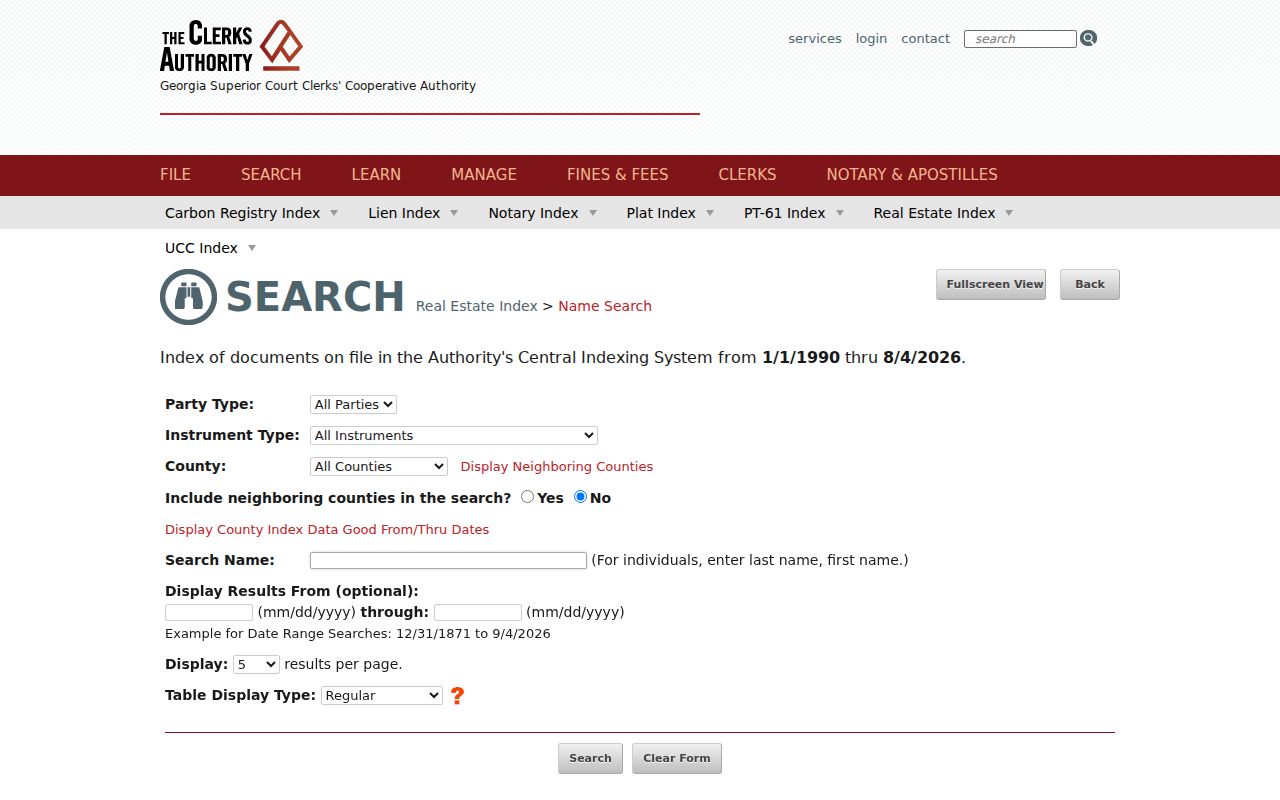
The search form shows the route only. Every former owner still needs a matching deed image and legal description. Search the exact legal name first. Then try initials, prior surnames, married names, trust or estate forms, and corporate suffix variants. Record each spelling and filter you use. When a search comes up empty, switch to the other party or a known book-and-page citation, since a blank result only means that stated scope returned no hit.
Reconstruct Glascock Ownership Backward
Work from the present toward the past. A person joins the chain only when the deed image and legal description tie that owner to the same tract. Similar names are not enough. Close dates or a shared mailing city do not carry the chain either.
- Find the newest deed by searching the current assessment name as grantee. Save the index row and image.
- Read the grantor, recording stamp, legal description, book/page, and referenced prior deed from that image.
- Search that grantor as a grantee in an earlier date range. Compare tract descriptions before adding the row.
- Repeat until the requested period or a documented stop, such as no index hit, no image, name ambiguity, or a pre-online book.
- Grantor
- The party conveying the interest stated in the deed.
- Grantee
- The party receiving that stated interest.
- Chain of title
- The ordered sequence of instruments tied to the same land.
- Reverse index
- An index arranged to help find grantees or grantors, depending on the search direction.
- Quitclaim and warranty deed
- Different deed forms with different assurances; neither label replaces reading the instrument.
Match Glascock Deed Descriptions
Read a deed image closely. Check the execution and recording dates. Then verify party names, consideration language, book and page, prior deed citation, and the full legal description. Note any parcel or map clues, easements, reservations, restrictions, signatures, and exhibits. Parcel numbers can change over the decades, while the legal description and plat reference tend to hold steady as stronger anchors.
Never grab the first same-name row. Compare acreage, tract calls, adjoining owners, land lot or district, and the present deed's own prior citation. Index labels can mislead. A row marked "deed" may turn out to be a correction, estate deed, or affidavit, so use the document's actual terms and save both the index entry and the image.
Keep an encumbrance trail beside the chain. Security deeds, assignments, releases, liens, judgments, easements, rights-of-way, and restrictive covenants can all touch the same parcel without naming a new fee owner. Search each owner during the holding period. Label unconfirmed hits plainly.
Glascock Plats Support Prior Owners
A recorded plat can be a gold mine. It may name the original owner or developer, fix the lot and block, and show street dedications, adjoining tracts, easements, access, and later revisions. Search the GSCCCA plat docket by name or by book and page whenever a deed supplies a citation. The portal's property and subdivision mode does not list Glascock as a participating county. So skip that path. The gap is not proof that plats are missing. Ask the clerk for a plat book and page, then compare its lot or tract against every deed in the chain. Easements and rights-of-way often explain changes in use. They rarely change the fee owner.
Estates Can Break Glascock Chains
Prior owners can hide behind more than a personal name. An estate, a group of heirs, a trust, or an LLC may hold title. It can do so at some point in the chain. Search each name form separately. The Georgia Corporations Division shows an LLC's registration history, agent, officers, and legal name. It cannot prove who truly benefits from the land. Estates need special care. A probate order or death record is only a lead. It transfers nothing by itself. Track down the deed from the estate or the heirs. Confirm the clerk recorded it against the same tract. When the link is missing, label it a probate or estate transfer not yet linked. Do not guess from family lore.
Old Glascock Names Aid Research
Glascock County dates to 1857. Old deeds rarely carry modern street addresses, so local history becomes the map. Gibson's courthouse past helps place early tracts. Mitchell's railroad roots help too. Edge Hill's Jule Wilcher Quarters adds another anchor. DCA plans add old road names, landmarks, and historic structures. These clues can steer a deed-book search. But they prove neither current ownership nor a legal boundary. The Glascock County Public Library provides genealogy databases and local research access. It is part of Oconee Regional Library. Which deed runs, newspapers, directories, or obituaries survive varies, so ask staff directly. Use the library and the historical society to gather names and dates. Then return to the recorded deed, plat, or probate file for actual evidence of ownership.
State Glascock Chain Limits
A former owners search should end where the evidence ends. That is an honest result, not a failure. State the last instrument matched, the date range covered, and every name variant tried. Explain why the next link stays missing. For the oldest Glascock volume still held locally, confirm current copy fees and counter hours with the clerk. Ask staff how much research they will perform. Historical maps and surveys supply context, and a Georgia-licensed surveyor can resolve a disputed boundary. Neither creates a conveyance that never existed. Need a copy of one instrument already found? Use the separate deed-record route. The backward chain and its stopping point are the whole purpose here.
Lawful use. Research prior Glascock owners for house history, estate work, title review, or due diligence. Never use the chain to stalk, harass, or expose a living person.