
Types of Glascock County Deeds
The Superior Court Clerk keeps the records. Deeds, plats, liens, judgments, and other land instruments file in that office, and each recorded image can show dates, parties, consideration, the legal description, prior deed citations, easements, reservations, signatures, and exhibits.
| Deed Type | What It Does | Common Use |
|---|---|---|
| Warranty deed | Conveys an interest with stated warranties | Ordinary sale |
| Quitclaim deed | Conveys whatever interest the grantor holds | Family transfer or cleanup |
| Estate deed | Conveys through an estate representative | Estate transfer |
| Sheriff's deed | Records a transfer through a stated proceeding | Judicial sale |
| Tax-sale deed | Records the purchaser after a tax sale | Delinquent-tax process |
Not every filing conveys land. Security deeds, liens, assignments, releases, easements, and restrictions can bind a parcel while title stays put, so search each filing family separately.
Walk the Glascock Deed Chain
The GSCCCA index accepts GLASCOCK, a grantor or grantee role, instrument type, name, date range, and display options. Start with the newest likely grantee and match the legal description before trusting any hit.
- Search the assessment name as grantee in GLASCOCK.
- Open the deed and match description, acreage clues, road, plat, and prior citation.
- Take the grantor and search that party as an earlier grantee.
- Repeat while saving dates, parties, book, page, and gaps.
- Grantor
- The party conveying an interest.
- Grantee
- The party receiving it.
- Chain of title
- The linked sequence of recorded conveyances.
- Book and page
- The citation used to retrieve a Rugby volume entry.
Glascock Deed Search Controls
The GSCCCA name form offers real control over a deed search. Party role comes first. Then comes a long instrument list, county, and a neighboring-county choice. Add a legal name up to 70 characters, dates, row count, and display style. Initials, prior surnames, estates, trusts, and entity suffixes often hide the row you need.
The Authority says every county is indexed since at least January 1, 1999. GSCCCA does not state Glascock's earliest deed image. Older books call for a clerk inquiry.
The official GSCCCA real-estate name form lays out each of these inputs.
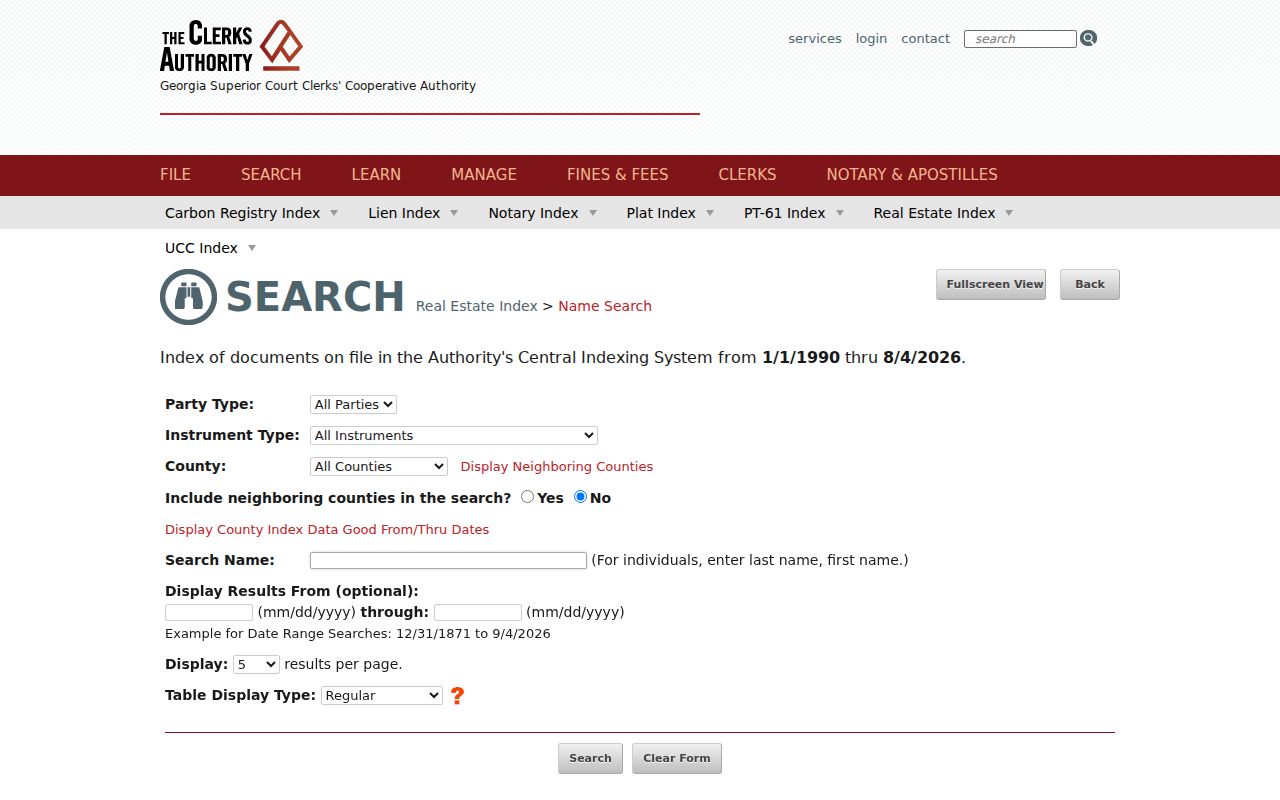
The form reveals nothing about Glascock's earliest deed image.
Glascock Plats and Liens
Use the plat docket for recorded maps. A separate lien docket holds claims. Glascock sits outside the property and subdivision search mode, so a deed citation or clerk-provided book and page is the safer route.
Work through security deeds, assignments, releases, tax liens, judgments, easements, rights-of-way, restrictions, and cancellations. An index hit stays a clue. Confirm it against the image and its legal description.
Glascock Legal Descriptions Control
Parcel numbers and street labels can change. So follow the land lot, district, metes and bounds, roads, adjoining owners, acreage, and plat citations.
Glascock County was created in 1857, with the courthouse in Gibson. That explains old deed language about public roads and the courthouse square. That context guides a search. It does not prove present ownership or a surveyed boundary.
Glascock Filing Alert Limits
GSCCCA FANS offers voluntary forward-looking alerts for selected matches. It is not a backward title search, and silence from the alerts proves nothing about what was filed.
Get a Glascock Deed Copy
GSCCCA covers indexed material and available images. For a missing image or an older volume, call the Superior Court Clerk at 706-598-2084 with the county, party names, instrument type, dates, and book and page. Ask about counter hours, mail service, payment, certification, the earliest local volume, and current copy charges.
A certified copy authenticates the filed copy. It is not a title opinion.
Recorded, not guaranteed. Glascock County deed records show what reached the books. They do not resolve every unrecorded interest, redemption issue, or title defect.
Read a Glascock Deed Image
Read the recording stamp first, since it anchors the record. Then capture the instrument label, execution and recording dates, full party names, consideration text, legal description, map or parcel references, prior deed, easements, reservations, restrictions, signatures, witness, notary, and exhibits. Save the index row and image together.
Execution and recording dates are not interchangeable. A release can arrive after payoff, an estate deed may rest on probate authority, and a security deed assignment may name a different lender. The image exposes them. A one-line index row never will.
Glascock Same-Name Deed Checks
Never grab the first result for a common name. Compare party role, instrument, date, location, acreage, legal description, and the current parcel's citation. Names hide in many forms. A middle initial, a prior surname, an abbreviated trust or estate, or an exact business suffix can surface the right row.
Search the other party when a name fails. Family land may pass to several heirs or an estate, and a company deed may use a trade style unlike its current state filing. Keep a query log. That way a later reader can tell a real negative from a narrow search.
Glascock Deeds Before Online Coverage
Statewide indexing covers every Georgia county since at least 1999. That figure does not establish Glascock's first image. Ask the clerk for the county good-from date. Ask also for the earliest local deed book, plat format, and any material available only at the counter.
Georgia Archives may hold older clues. So may the local historical society and library resources. A catalog entry does not put a deed image online. Follow every abstract or history reference back to the recorded volume.
Tax-sale deeds in Glascock.
A tax-sale deed belongs in the deed chain. It does not alone prove clear title. Compare the Tax Commissioner's delinquency, levy, sale, redemption, and excess-funds facts against GSCCCA liens, deeds, releases, and later instruments.
Glascock County publishes no official online sale calendar. Skip third-party dates entirely. Ask the tax office for status tied to the parcel, and record the confirmation date.
Status terms for Glascock instruments.
Careful language matters with Glascock County deed records. An index entry alone is just a clue. Say so. When you open an image and it lines up with the parcel's legal description, you can call it a match. A release counts only once its document turns up. Everything else stays open. A narrow name search never proves a parcel clear, a debt settled, or a lien gone.
Do not overread what you find. An unreleased security deed might still be paid off, since the release can sit in a separate filing or under another party's name. An easement on the plat may burden one slice of the tract and not the rest. Covenants can carry amendments, and a tax-sale deed may still allow redemption. The instrument text answers these questions. For high stakes, bring in a title professional who reads deeds for Glascock County property records every day.
Prepare for a Glascock clerk call.
Get organized before you phone the clerk. Gather the parcel number and the current deed citation. Add exact party names, the likely instrument type, and your date range. Then ask pointed questions. When does the online index and image coverage for Glascock County deed records begin? What is the earliest volume available at the counter? How are deeds and plats numbered, and do liens, releases, and judgments run through GSCCCA? Request the fee schedule too. Plain copies, certified copies, images, and staff searches each carry their own charge.
Keep the clerk's role in bounds. Staff can point you to a record or an access route. They cannot certify who owns a property in Glascock County. If your chain stalls, name the exact gap. It may be an unreadable prior citation, a legal description that will not match, a missing image, or an unknown estate name. That precision beats guessing from a shared surname or a familiar address.
Use Glascock plat citations.
A plat reference can push the chain past names alone. Record the plat name, book and page, recording date, surveyor, lot and block, and any road dedication, easement, access strip, or revision noted on it. Set those details beside the current deed. If the acreage disagrees, flag the discrepancy and hunt down the recorded survey or the licensed surveyor's work. Never redraw a boundary from the online GIS map yourself.
Read Glascock deed dates.
Execution, recording, and index dates are three different things. Keep them separate. Their sequence often explains why the assessor's owner of record and the recorded grantee have not caught up with each other yet.
Keep a Glascock deed-chain worksheet.
Track one instrument per row. Log the sequence number, instrument type, execution date, recording date, grantor, grantee, county, book, page, and instrument number. Fill in the instrument number when the deed has one. Add the legal-description match, the prior deed reference, any easement or restriction, image status, and open questions. Rows stop dates and parties from melting into a story. When the chain breaks, write down exactly which field failed. The failure might be an unreadable citation, a tract that will not match, an absent image, or an unknown estate name.
Build backward one step at a time. Search the current owner as grantee. Open the likely image. Pull the grantor from that deed. Then hunt for that grantor as an earlier grantee. Keep repeating only while acreage clues, roads, land lot or district terms, adjoining owners, and plat references still point to the same land in Glascock County. A shared surname or a close recording date proves nothing. Run lien and plat searches on their own. The real-estate name index for property records covers neither encumbrances nor maps.
Glascock Recorded Instrument Meanings
Not every instrument in GSCCCA that touches a Glascock County parcel is a simple sale deed. A security deed records a financing interest. An assignment moves that interest to a new party. A release or cancellation often shows up later and under a different name. Easements and rights-of-way may burden only part of a tract or benefit a neighboring one. Restrictive covenants can be amended, released, expired, or disputed. The one-line index rarely answers those questions.
Tax-sale, sheriff's, foreclosure, estate, and trustee deeds need the same care. A tax-sale deed can remain subject to redemption. An estate transfer may depend on probate authority. A foreclosure instrument must be compared with its related security deeds, assignments, notices, and later conveyances. Report only the status the recorded image supports. Phrases such as index hit with image not inspected, image located with description matched, release located, and status unclear fit limited work. Avoid calling title clear, a debt paid, or a parcel lien-free after a narrow search of deed records.
Older Glascock Deed Access
GSCCCA's statewide explanation says every Georgia county is represented from at least January 1, 1999. The central form shows a wider system range. But neither fact proves Glascock County's earliest indexed or imaged deed. The county's good-from date still requires direct confirmation. The same goes for the first online image, oldest clerk volume, and availability of older plats. Keep index coverage and image coverage separate, because a citation can exist when no viewable image does.
Ask the Superior Court Clerk whether staff can trace an older book and page from a current citation. Ask which volumes remain at the counter and whether mail requests are accepted. The Glascock historical society may hold family, newspaper, or local-history leads. A regional library may hold them too, and either can support a property search. Treat a catalog entry or family history as a clue. The recorded book remains the land-record source for any parcel.