
Glascock County Value Types
In Glascock County, two offices divide the work. The Board of Tax Assessors sets taxability and fair market value, while the Tax Commissioner bills and collects the tax that follows. The assessor's qPublic route is where assessment data lives. It is not a payment portal, and a tax bill amount is not itself a property value.
| Value | What It Is | Where |
|---|---|---|
| Fair market value | The assessor's estimate of full value as of January 1 | Board of Tax Assessors and qPublic |
| Assessed value | Forty percent of fair market value under Georgia's rule | Assessment record |
| Taxable value | The figure after applicable exemptions or special treatment | Assessment and tax records |
| Recorded sale price | Transfer context reported in a deed or PT-61 record | Clerk and GSCCCA |
Georgia's general assessment ratio is 40 percent. A fair market estimate yields a lower assessed figure. Exemptions and millage enter the calculation afterward. One mill equals one dollar per thousand dollars of assessed value, so the millage rate converts assessed value into a tax amount. The ratio explains the relationship; it never turns an assessed value into a forecast sale price.
Glascock Values Begin January 1
The county's general information says fair market value is determined as of January 1. Owners may file a property tax return from January 1 through April 1 when they believe a value should change. If no return is filed, the prior return can stand, subject to assessor review. This annual date frame is more useful than comparing screens without noting their digest year.
The assessor may inspect property as part of its valuation work. The qPublic landing page says field appraisers may visit properties and should carry identification. An inspection notice does not mean a parcel was sold, reassessed for a particular cause, or placed under enforcement. It is part of the valuation function.
Glascock County Assessment Notices
An assessment notice is what starts the appeal clock. The Board of Tax Assessors issues one whenever it changes or sets a value. Glascock County's published route allows 45 days to appeal. That window runs from the notice itself, not from the day someone happens to open qPublic. Keep the notice, the envelope or delivery detail, the parcel number, the tax year, the stated value, and your reason for disagreement.
This page stops at what the figures mean. The Glascock County property tax records material covers the tax process, exemption filings, and the appeal path. Challenging a value is one thing. Disputing millage or bill collection is another.
Exemptions Change Taxable Value
Exemption programs shape taxable treatment, not market value. Homestead, senior, disabled-veteran, surviving-spouse, conservation-use, and Freeport details all appear on the county-linked qPublic pages. The county sets April 1 as the key filing date. Current-year homestead and current-use applications must meet it.
Where to file is less clear. County sources direct some filings to the assessor and others to the Tax Commissioner. Confirm the receiving office before delivering anything. A smaller taxable figure never means the market estimate dropped.
Compare a Glascock Property Value
Glascock County routes assessment lookups through the qPublic landing page, where the live parcel search carries each parcel's assessment record. Fields and tabs can vary, so rely on the assessment record when you can open it, and keep a phone or counter fallback ready through the Board of Tax Assessors at 706-598-2863.
The county's own assessment explanation spells out how values are set.
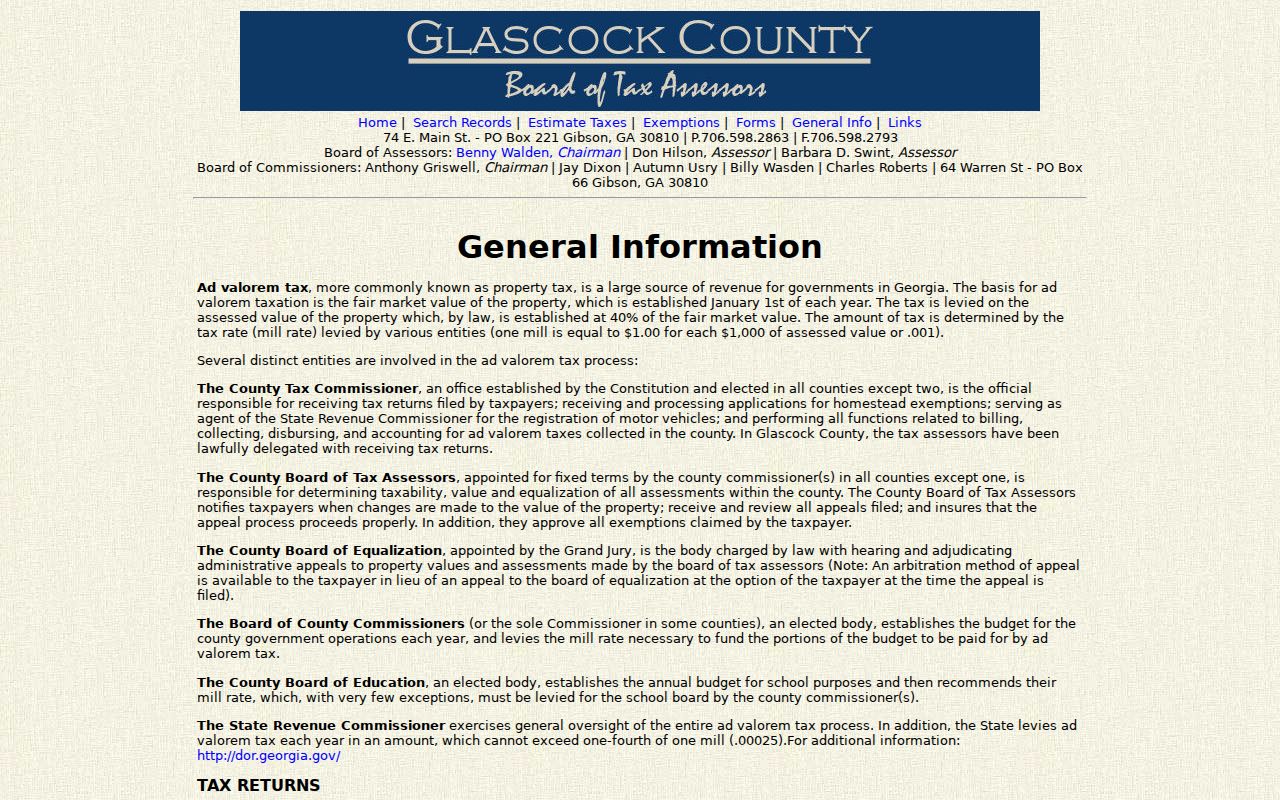
The captured source documents the valuation rule, not a parcel-specific appraisal or sale estimate.
- Search the address or obtain its parcel number from the assessor.
- Record the digest year, fair market value, assessed value, and any land or improvement split shown.
- Note exemptions or special-use treatment without treating them as market discounts.
- Search the latest transfer through GSCCCA and compare its date and consideration context.
- Keep each source date beside the number before drawing a conclusion.
- Assessed value
- The statutory share of fair market value used in Georgia's tax system.
- Fair market value
- The assessor's full-value estimate as of the valuation date.
- Assessment ratio
- The percentage that relates assessed value to fair market value.
- Consideration
- The value stated or reported for a transfer, which may need context.
- Reassessment
- A new review or change to the value placed on the digest.
Glascock Sale Records Add Context
Deeds in Glascock County are recorded by the Clerk of Superior Court. GSCCCA supplies statewide real-estate and PT-61 search routes on top. A deed image can show grantor, grantee, instrument type, book and page. It can also show recording date and legal description. PT-61 data adds sale-price and transfer-tax context. Neither one proves present market value alone.
Start with a known owner name as grantor or grantee. Search county GLASCOCK. A parcel's book and page offer a direct route when available. GSCCCA's property and subdivision mode does not list Glascock as a participating county. Address-based deed results are not a given.
Why Glascock Values Differ
Timing explains most mismatches. A January 1 assessment can predate a sale, an improvement, a land split, or a market shift. Record type is the second cause, since fair market, assessed, taxable, and recorded consideration each answer a different question. Condition is the third. A mass appraisal cannot match a parcel-specific inspection.
Special programs add their own wrinkles. Conservation-use treatment can change the tax math while the fair market estimate sits in a separate field. Related-party transfers, estate conveyances, gift deeds, foreclosure deeds, and tax-sale deeds may all carry figures far from an open-market price.
Current Glascock Record Limits
Exact live controls on the qPublic portal could not be checked. The site blocked the visit with a Cloudflare 403 error. That block is not proof the county system is down. It simply means some details remain unknown. These include output fields, refresh dates, sales displays, and parcel-card lag. Recheck the portal and note its displayed date before quoting any figure.
Planning Is Not Property Value
Glascock County, Gibson, Mitchell, and Edge Hill share a joint 2025 comprehensive plan. The county and each city adopted it on separate dates in early 2025. The plan is a good source for land-use policy, infrastructure, and long-range context. It is not a parcel appraisal, zoning verification, or current owner of record.
The 2020 plan also sketches conceptual character areas. Their boundaries may cross parcel lines. A Countryside, Downtown Gibson, Gateway, or Watershed label can shape research questions. It should never drive an automatic price adjustment. For the parcel itself, check the assessor record, deed, plat, and current jurisdictional records.
Keep a value worksheet for each parcel. Log the digest year, fair market value, assessed value, taxable value, and any land-versus-improvement split. Add exemptions, deed date, transfer type, and any consideration figure. A number stripped of its year or record type invites false comparisons. If qPublic shows no refresh date, mark that field unverified and ask the assessor. Treat deed amounts from estate, gift, foreclosure, tax sale, or related-party transfers as something other than a normal market sale. Estate, gift, foreclosure, tax sale, and related-party transfers are not normal market sales. Treat their deed amounts accordingly. A Glascock County property value only holds up when each figure keeps its source, purpose, and date attached. Each figure needs its source, purpose, and date. Otherwise the value will not hold up.
Glascock Property Value Limits
A county assessment is a mass-appraisal result. It exists to serve the property tax system. It is not a survey, title opinion, repair estimate, or promised sale price. The last recorded transfer may not even be an arm's-length sale, so compare dates, deed type, parcel identity, and exemptions before calling two figures inconsistent.
For a purchase, sale, estate, or financing decision, get the professional review the task demands. Public records still matter. They show what the county assessed and which instruments were recorded. But they cannot replace a licensed appraisal or a title examination.
Value is not price. A Glascock County assessed value supports taxation. It does not state what the parcel will sell for and is not an appraisal.