
Fields in Glascock Tax Records
Two offices split the work. The Board of Tax Assessors decides taxability and sets value. The Tax Commissioner issues the bill and collects it. Compare their records by parcel number and year so each figure matches the right office.
| Field | What It Shows | Where |
|---|---|---|
| Fair-market value | County estimate used for assessment | Assessor digest |
| Assessed value | 40 percent assessment base under county guidance | Assessor digest |
| Exemptions | Relief applied to qualifying property | Assessor and tax workflow |
| Bill and payments | Charges, receipts, balance, penalties, and interest | Tax Commissioner |
| Delinquency | Past-due, levy, sale, or redemption questions | Tax Commissioner and deed index |
The numbers are not interchangeable. A recorded sale price, fair-market value, assessed value, taxable value, and bill balance each answer a different question. One mill simply means one dollar of tax per $1,000 of assessed value.
Look Up a Glascock Tax Bill
The Government Portal landing page displays property-tax and tag-and-title tiles. No deep bill query is available there, so owner, address, parcel, receipt, and account lookups are not offered online. Call the Tax Commissioner at 706-598-3151 for the actual bill.
- Find the parcel ID and assessment year through qPublic or the assessor.
- Give the Tax Commissioner the parcel, address, tax year, and bill number if known.
- Ask for billed amount, payments, balance, penalties, interest, and receipt information.
- For delinquency, ask separately about levy, sale, redemption, and excess funds.
- Assessed value
- The 40 percent value base described by county guidance.
- Mill
- One dollar of tax per $1,000 of assessed value.
- Homestead exemption
- Relief subject to ownership, use, filing, and other rules.
- Tax lien
- A recorded claim tied to unpaid tax, subject to its own process.
Glascock Returns and Due Dates
Glascock County publishes real-estate and business personal-property taxes as generally due November 15. Real-property returns run January 1 through April 1 after property is acquired or changed. A late required return draws a 10 percent penalty plus interest.
A mobile home sitting in Glascock County on January 1 must be returned. The location permit goes with it by April 1. Keep the land parcel and the mobile-home return separate. Keep the permit and the bill separate too. All may concern one site.
Glascock Exemption Paths
The county exemption page describes homestead, age-based, disabled-veteran, surviving-spouse, current-use, conservation, and Freeport relief. Local HB-302, HB-918/919, and HB-1912 materials add county-specific choices.
The county pages conflict on whether homestead material is received by the assessor or Tax Commissioner. Confirm the current office and method before filing. April 1 is the critical published date for current-year homestead and current-use filings.
See the successful Glascock exemption capture below.
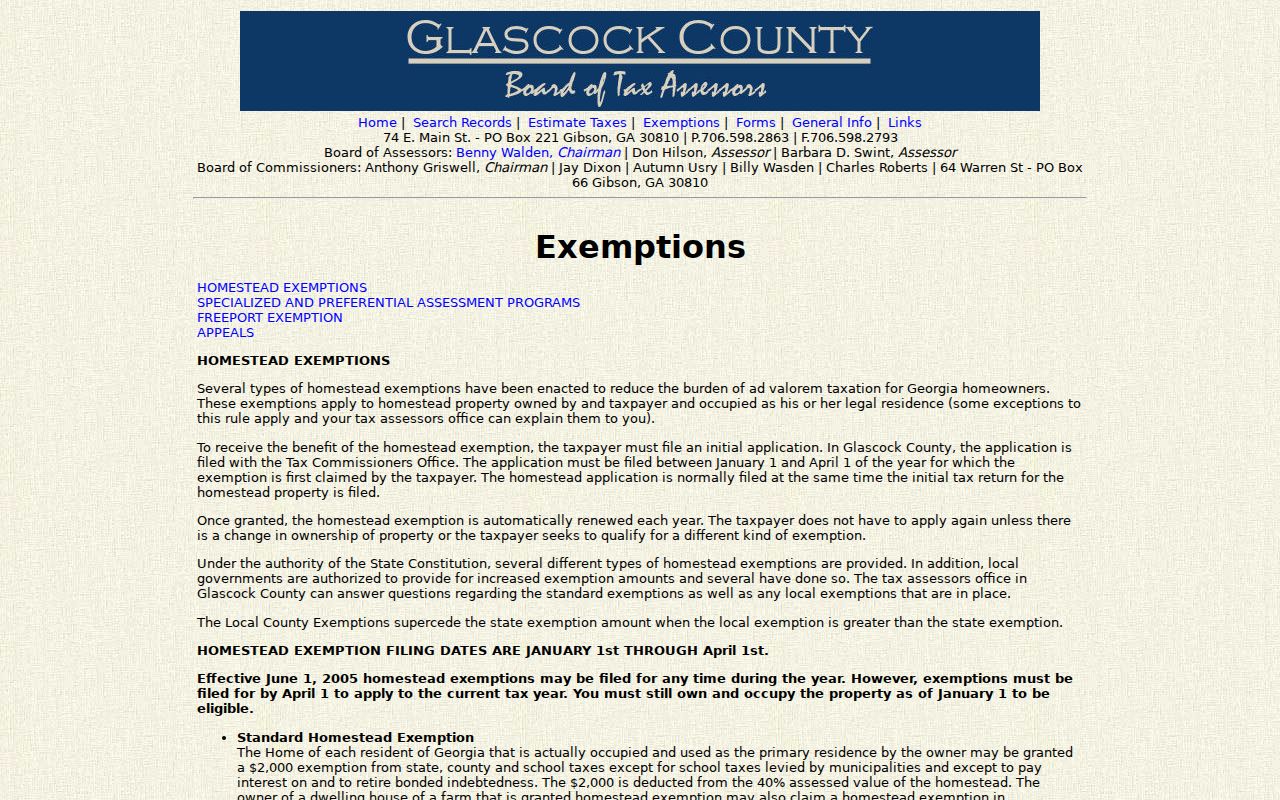
Note: The official page lists each program, but eligibility rules and current submission methods still control every claim.
Glascock Current-Use Covenants
Rural land has its own track. County material describes a 10-year conservation-use covenant, a statewide 2,000-acre cap, a value formula, annual increase limits, and a $10 recording fee. Breaking a covenant can trigger a penalty tied to the tax savings plus monthly interest.
Acreage alone never qualifies a tract. The application probes ownership, use, leases, restrictions, zoning, and proof. A sale continues a covenant only in stated circumstances.
Glascock Delinquency Evidence
Glascock County publishes no current online tax-sale list. A past-due bill is not a sale. An unpaid account may be levied and sold. Ask the Tax Commissioner for delinquent years, fi. fa. or levy, notice, sale date, redemption, and excess-funds status. Then search GSCCCA for a tax-sale deed, sheriff's deed, lien, release, or later instrument. A tax-sale deed alone proves neither marketable title nor the end of redemption.
Appeal a Glascock Assessment
The county appeal page allows 45 days from the notice of change to file. Filing goes to the Board of Assessors. Taxability, value, and uniformity are the stated grounds. If nothing changes, the case moves automatically to the Board of Equalization. Superior Court and arbitration routes are also described.
Save the notice and the parcel number. Also save the value, year, ground chosen, requested correction, and proof of timely filing. A millage or collection dispute belongs with the Tax Commissioner. A refund claim runs on a separate three-year route for illegally or erroneously paid taxes.
Appeal window. File a Glascock assessment appeal within 45 days of the notice of change and keep proof that the Board of Assessors received it.
Glascock Value and Bill Roles
The assessor can explain value, taxability, exemptions, and the assessment notice. It cannot change a payment ledger. The Tax Commissioner handles the bill, balance, collection, refund, or delinquency. That office never sets the assessed value. Bring the parcel ID, tax year, and the notice or bill at issue.
If an exemption looks wrong, compare the assessor record against the bill. Ask both offices which year and filing controlled. Never assume relief followed a new owner or a redrawn parcel automatically.
Glascock Refunds Versus Appeals
A value objection uses the assessment appeal. A millage or collection question goes to the Tax Commissioner. The county requires a claim for illegally or erroneously paid taxes to reach the commissioners within three years. One route never substitutes for another.
State the problem plainly: disputed value, missing exemption, wrong parcel, unposted payment, or refund claim. Save every notice, receipt, envelope, and proof of filing.
Glascock Tax Record Requests
Ask for a specific parcel and tax years. Useful fields include billed amount, payments, balance, penalty, interest, delinquency, levy or fi. fa., sale date, redemption, excess funds, and public deed citation. Ask which office holds anything the Tax Commissioner does not maintain.
Phone and office contact remain the essential access channels. A zero balance on one displayed year never establishes that older years were paid.
Glascock Assessment Evidence
A Glascock appeal should target taxability, value, or uniformity, not merely the final tax amount. The grounds carry the case. Keep the notice of change, the parcel card, photographs, property facts, and the comparable property records you relied on. Also keep the value you are requesting. File inside the published window. Retain proof. If the Board of Assessors leaves the value unchanged, the county page says the matter moves on to the Board of Equalization.
The assessor's published material separates fair-market value from assessed value. Georgia's 40 percent rule turns the first figure into the base assessment. Exemptions may then shrink the taxable amount. The tax bill applies its levies. A recorded consideration amount stays a transfer fact rather than the assessor's market conclusion.
Glascock Mobile Home Records
Mobile homes split their records across local offices. The county says a home located in Glascock on January 1 must be returned by April 1 when the owner seeks the location permit. One site can therefore carry several files. The land assessment, mobile-home return, permit, and bill may all relate to it without becoming one record.
An appeal window also exists during the return period. Mobile and modular homes get a second route, open for 45 days after the bill. Confirm which notice starts the clock. Bring the land parcel ID, mobile-home identifiers, bill year, return date, and permit information when asking the assessor or Tax Commissioner to reconcile the files.
Date each Glascock tax status.
Record the parcel, tax year, source, status date, and office confirmation for every Glascock tax check. That trail prevents mistakes. No prior-year balance or exemption then passes as current.
Verify a Glascock tax sale.
A bill balance, levy, tax sale, deed, redemption, and excess-funds status are separate facts. Confirm each one with the office or recorded instrument that holds it.
Check Glascock exemption details.
The county exemption page describes standard homestead as a $2,000 reduction from the 40 percent assessed value under O.C.G.A. section 48-5-44. Age-65 county relief carries an income test. The page also summarizes age-62 school relief, disabled-veteran relief, and unremarried-surviving-spouse relief. These summaries are not the current forms, proof requirements, or controlling law. Confirm the form, year, and receiving office. Never rely on a summary amount alone.
Local materials add HB-302 senior school relief for a home and up to five acres. HB-918 and HB-919 inflationary freeze material covers a home and up to three acres. HB-1912 county senior relief also covers five acres. The county pages conflict on the homestead desk. Some send applications to the assessor, others to the Tax Commissioner. Ask both offices which desk currently receives the application and how proof should be submitted.
Read Glascock conservation tax records.
Conservation treatment shapes many rural Glascock parcels. County material describes agricultural property receiving a 30 percent assessment treatment. Conservation-use land or timber can enter a 10-year covenant. The rules are specific. Applications are due April 1, recording costs $10, and the statewide ceiling is 2,000 acres. The value formula uses 65 percent income and 35 percent market value, with annual increase limits. Recheck those numbers against the active form.
Breaking a covenant can cost you. The described penalty runs twice the tax savings plus one percent per month, and a sale may continue the covenant in some circumstances. Acreage alone never establishes eligibility. The form asks about use, leases, ownership structure, restrictions, zoning, and supporting documents. Save the covenant year, recorded reference, parcel acreage, owner type, and application result when comparing the exemption record with a later bill.
Build a Glascock tax-sale worksheet.
The county publishes no online tax-sale calendar. No bidder page, redemption tracker, or notice archive appears on its site either. For an alleged sale, ask the Tax Commissioner. Request the delinquent year, parcel ID, taxpayer label, fi. fa. or levy date, notice date, sale date, purchaser, redemption status, excess-funds status, and any public book and page. Record the date of the office response. Never convert a delinquent balance into a sale claim.
Then search GSCCCA for a tax-sale deed, sheriff's deed, lien, release, quitclaim, or other later instrument. Match any deed image to the legal description. Delinquency without a sale deed stays delinquency. A deed appearing while redemption remains open gives you both facts at once. Georgia Title 48, Chapter 4 is the legal starting point. Deadlines and redemption amounts still require current statutory and county confirmation.